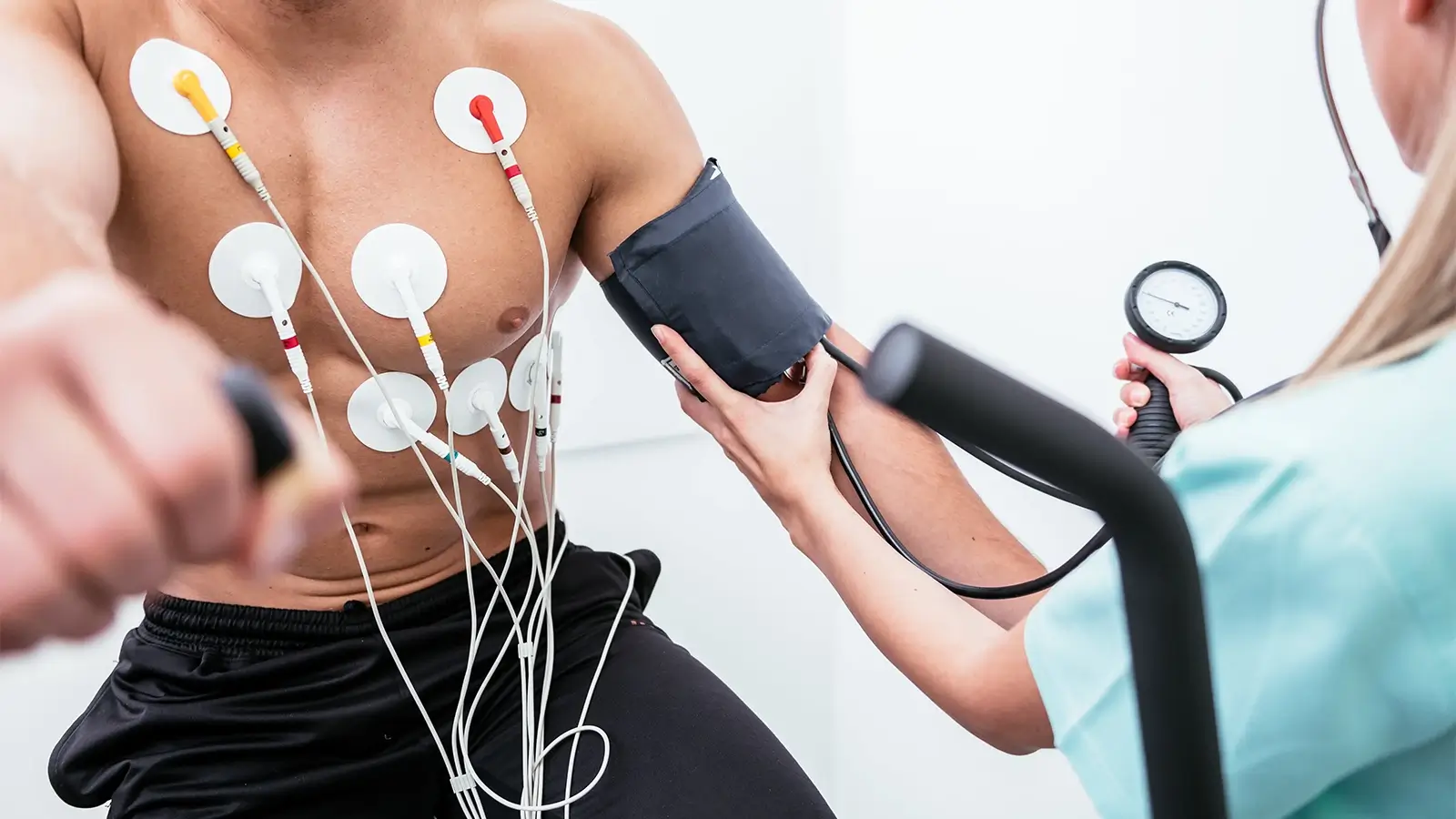
PRIVATE EXERCISE TOLERANCE TEST LONDON

£350

  • Free Preliminary Assessment
  • Available At Multiple Locations
  • All Private Insurances Accepted
  • Same-Day Appointments Available
  • All Tests Done In One Session

FAQs About Exercise Tolerance Test

An exercise tolerance test (ETT), also known as an Exercise ECG or a stress test, is a type of electrocardiogram (ECG) test that assesses the electrical activity of your heart under physiological stress. An ETT can show you how your heart works whilst you are physically exerting yourself.
An exercise tolerance test is an important cardiac diagnostic test. During an ETT, the electrical activity of your heart is recorded while you are exercising, on a treadmill or exercise bike. Exercise makes the heart contract faster and harder. When you exercise, your heart beats faster and your coronary blood flow increases. An ETT can indirectly assess the blood flow within the coronary arteries bringing blood and oxygen to your heart. It can also assess your heart rate and your heart’s electrical activity during exercise and determine whether it is functioning correctly.

Some types of coronary artery disease show no abnormality when you are resting. This means that if you have a standard ECG that assesses your heart rate and the electrical activity of your heart at rest, your results may present as normal, and your condition may go undiagnosed.
You may be referred for an ETT for a number of reasons:
·   To assess the effectiveness of your current heart treatments and to determine whether other treatments would be more effective. For example, if you have a stent, an ETT can assess how well the stent is working.
·   If you have recently undergone heart surgery or had a heart attack or to determine whether you can safely have surgery.
·   If you are experiencing symptoms such as chest pain, palpitations or breathlessness that could be consistent with heart disease or blocked arteries.
·   If you have fainted or experienced symptoms whilst exercising, as this could be consistent with coronary artery disease.
·   To determine safe levels of exercise, depending on how well your heart functions when under stress. r.

The exercise tolerance test assesses:
· Any changes in your heart’s electrical activity.
·   Whether you have a blocked artery which is causing a reduction in blood flow and a reduction in the oxygen delivery to your heart muscle.
·  Any abnormal patterns in your blood pressure, including hypertension and hypotension.
·   An arrhythmia (an abnormality of the heart’s rhythm).

An ETT can help your cardiologist see whether your heart is getting enough blood from your coronary arteries when you engage in physical activity. It can show how well your heart functions when under stress and detect any problems with the blood flow in your heart.
ETTs are usually used to diagnose coronary artery diseases, where your coronary arteries become narrowed. Narrow coronary arteries will result in your heart muscle not getting enough oxygen. If you have an abnormal reading on an ETT, the most likely diagnosis will be coronary artery disease.

When you come in for your ETT, you will need to wear comfortable clothes and trainers. Small electrodes will be placed on your chest and will be connected to an ECG machine. You will then be asked to walk on a treadmill, starting at a slow pace. The incline and/or speed of the treadmill will then increase to make the exercise more difficult and increase your heart rate. You will be encouraged to exercise as hard as you can so we can see how your heart functions under stress. Make sure you tell the cardiologist if you begin to feel any chest pain or become too tired or short of breath and they will stop the test. The cardiologist will monitor you very carefully throughout the test. You may also be fitted with a blood pressure monitor so your blood pressure can be monitored at intervals. Your breathing will also be monitored throughout the test. .

An exercise tolerance test (ETT) usually lasts for between 10 and 15 minutes, depending on how long it takes to increase the intensity of the exercise and how quickly your heart rate reaches a high enough rate.

In the majority of cases, there are no complications associated with an ETT. However, in very rare cases, complications such as ischaemia or a heart attack can occur. Other rare complications include an arrhythmia –an irregularity of the heartbeat – triggered by the exercise, or the test could cause excessively high or low blood pressure. However, these complications are very rare, and you will be closely monitored throughout the ETT to reduce the risk of complications.

ELECTROCARDIOGRAM PRIVATE ECG LONDON

£150

  • Free Preliminary Assessment
  • All Private Insurances Accepted
  • Same-Day, Urgent Appointments Available

WHAT IS AN ELECTROCARDIOGRAM (ECG)?

An Electrocardiogram is a quick, painless cardiac test that records your heart’s rhythm and electrical activity in a waveform. It shows your heartbeat, the strength & timing of the electrical impulses, as well as the size and positioning of the heart chambers, giving clear insights about your overall cardiac health.

HOW IS AN ECG TEST PERFORMED?

During an ECG, small adhesive electrodes are attached to specific points on your chest, arms, and legs. A small amount of lubricating gel is applied to your skin to reduce impedance and improve the transmission of electrical signals between the body and the ECG machine. Electrodes are attached to the machine to record your heart’s beats and electrical activity in the form of a graph. This procedure takes around 10 minutes to monitor the pattern of your heart’s electrical impulses precisely.

WHAT DOES AN ECG WAVEFORM SHOW? PQRST WAVE EXPLAINED

P-wave represents atrial depolarization, showing contraction of the atria (upper chambers of the heart). The QRS-wave represents ventricular depolarization, indicating contraction of the ventricles (the lower chambers of the heart). The T-wave shows ventricular repolarization, indicating the relaxation phase of the ventricles.

TYPES OF ELECTROCARDIOGRAM (EKG/ECG)

Your heart doctor will recommend the most suitable type of electrocardiogram based on your symptoms and any suspected heart condition.

Holter Monitor

A cardiac Holter monitor is a portable ECG device that records your heart’s activity continuously for 24 hours or more during normal daily activities.

Stress ECG Testing

A Stress ECG records your breathing and blood pressure rate during a physical activity to detect abnormalities in the heart and determine safe exercise levels after a heart attack or surgery.

Cardiopulmonary Exercise Test (CPET)

A CPET test measures how efficiently your body uses oxygen and how your heart, lungs, and muscles respond during exercise, helping doctors identify cardiac or pulmonary disorders.

Resting 12-Lead ECG

It is a standard test performed to record your heart’s electrical activity from 12 points on the body to detect heart conditions earlier, even before symptoms appear.

TYPES OF ELECTROCARDIOGRAM (EKG/ECG)

Your heart doctor will recommend the most suitable type of electrocardiogram based on your symptoms and any suspected heart condition.

Holter Monitor

A cardiac Holter monitor is a portable ECG device that records your heart’s activity continuously for 24 hours or more during normal daily activities.

Stress ECG Testing

A Stress ECG records your breathing and blood pressure rate during a physical activity to detect abnormalities in the heart and determine safe exercise levels after a heart attack or surgery.

Cardiopulmonary Exercise Test (CPET)

A CPET test measures how efficiently your body uses oxygen and how your heart, lungs, and muscles respond during exercise, helping doctors identify cardiac or pulmonary disorders.

Resting 12-Lead ECG

It is a standard test performed to record your heart’s electrical activity from 12 points on the body to detect heart conditions earlier, even before symptoms appear.

WHY HEART MONITORING VIA ECG IS IMPORTANT?

ECG is vital for analysing your heart condition and detecting irregular electrical signals linked to cardiovascular conditions. It helps identify early warning signs of heart disease, track ongoing symptoms, and decide on timely treatment.

  • Arrhythmias

    An ECG scan helps detect arrhythmias (abnormal heart rhythm) that leads to palpitations, dizziness, or fainting. Early detection helps your cardiologist find out any underlying causes and prevent complications.
  • Myocardial Infarction (Heart Muscle Damage)

    An ECG heart scan identifies changes in heart rhythm and electrical patterns associated with a myocardial infarction, commonly known as heart muscle damage.
  • Various Heart Diseases

    ECG analyses the heart’s rhythm, identifies the warning signs, and helps detect various heart conditions such as congenital heart disease, electrolyte imbalance, and cardiomyopathy.

FAQs

ECG leads are placed on the chest, arms, and legs in specific positions to record the heart’s electrical activity from different angles.

An ECG scan helps detect possible heart muscle damage caused by hypertension, allowing early intervention and monitoring of cardiac health.

A borderline ECG means minor abnormalities that are not significant but may require thorough evaluation depending on symptoms. 

Results of the ECG are typically available within minutes of completing the procedure. However, sometimes there may be a short delay if your cardiologist needs to review any unusual findings. 

Private Electrocardiogram price in London usually ranges from £50 to £150, depending on the clinic and whether a specialist review is included.

An echocardiogram creates images of the heart’s structure through an ultrasound, whereas an ECG records the heart’s electrical signals to detect any abnormalities in cardiac rhythm.

TRUSTED BY PATIENTS ACROSS LONDON

Google Reviews