
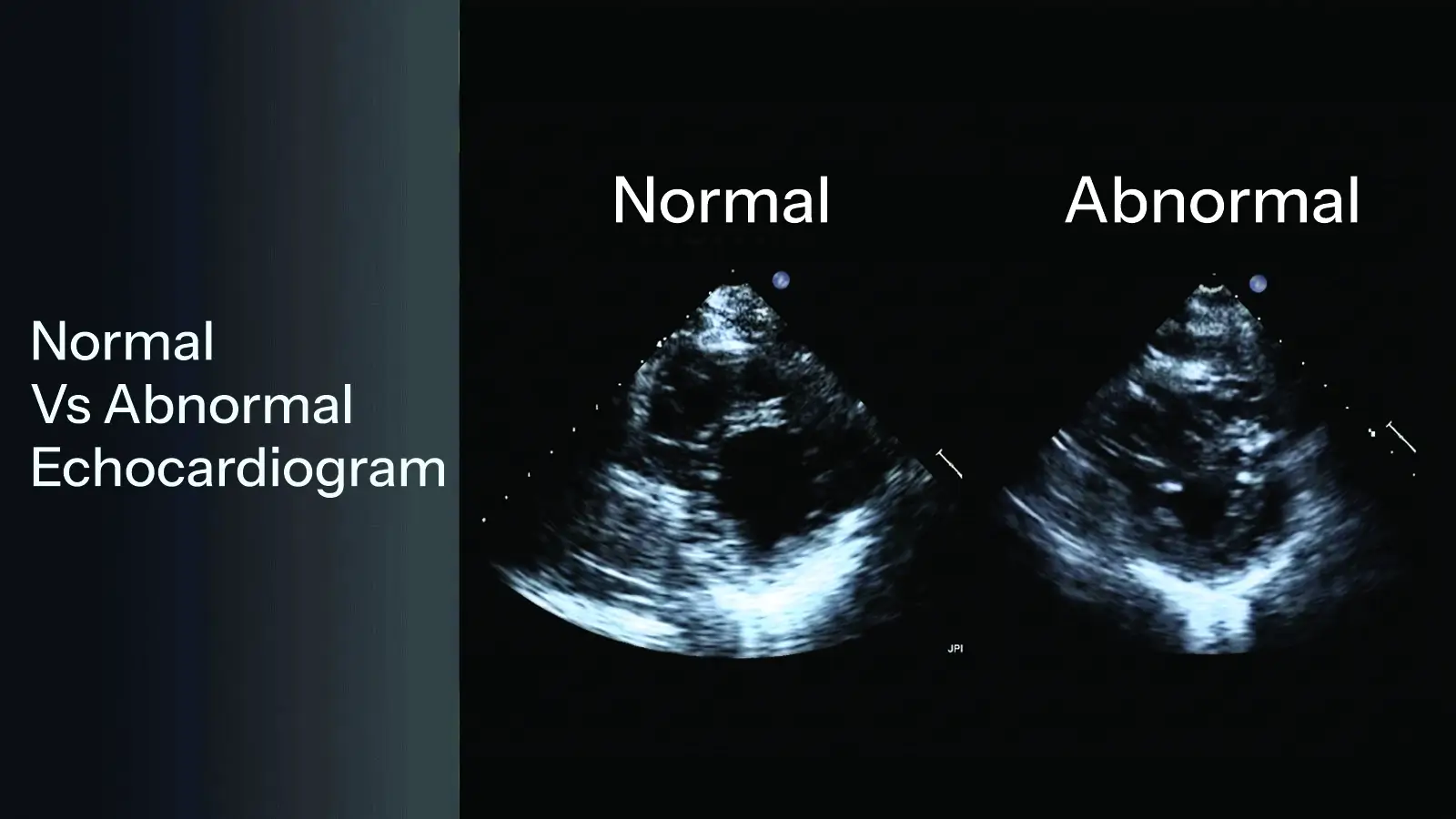
Understanding Echo Results: Normal Vs Abnormal Echocardiogram
Have you recently had an echocardiogram but are confused about the terms mentioned on your report? Don’t have any idea what ejection fraction, aortic stenosis, LVSD, or LVDD mean? This comprehensive article will guide you on everything about your echo scan results, common terms mentioned in the report, insights about normal vs abnormal echocardiograms, and what the indications of abnormalities are in the report.

Don’t Wait Weeks for Answers
Get fast, specialist-led heart checks with same-day or quick appointments
Understanding an Echocardiogram Scan
An echocardiogram (heart echo) is an ultrasound scan that helps doctors closely examine the structure and function of your heart. It uses sound waves to evaluate the heart’s pumping efficiency, chambers, valves, and blood flow, and creates clear, real-time images of the heart.
An echocardiogram is of various types, including:
- Transthoracic Echocardiogram (TTE): Also known as ‘standard echo’, it is a painless ultrasound performed by moving a probe on your chest using a gel.
- Transoesophageal Echocardiogram (TOE): Takes detailed images of your heart from inside your body through a small tube inserted into your mouth and down your throat.
- Doppler Echocardiogram: A specialised ultrasound that examines the speed and direction of blood flow through your heart.
- Stress Echocardiogram: Combines a heart ultrasound with a physical stress test to help doctors analyse the heart’s performance under physical stress.
Key Measurements in an Echocardiogram
Confused by the technical terms in your echo report or not sure what your results actually mean? Below, we’ve broken down the key information in a simple, easy-to-understand way to help you make better sense of your echo results.
Structural Measurements
- Thickness of the Heart Walls: It shows whether the heart walls are of normal thickness, too thick, or too thin.
- Left Ventricular End-Systolic Dimension (LVESD): It measures the size of the left ventricle right after it contracts, giving insight into how effectively the heart is pumping blood.
- Left Ventricular End-Diastolic Dimension (LVEDD): It measures the size of the left ventricle when it’s relaxed and full of blood, helping assess overall heart function.
Heart Function Indicators
- Ejection Fraction (EF): Measures how much blood is pumped out of the heart with each beat. A normal EF typically falls between 55-70%, while a lower value may point to heart failure.
- Cardiac Output (CO): It refers to the total volume of blood the heart pumps out per minute
- Stroke Volume (SV): The amount of blood ejected with each heartbeat, measured in millilitres.
Blood Flow Assessment
- Doppler Flow Velocities: Measures the speed and direction of blood flow as it moves through, helping identify any blood flow abnormalities.
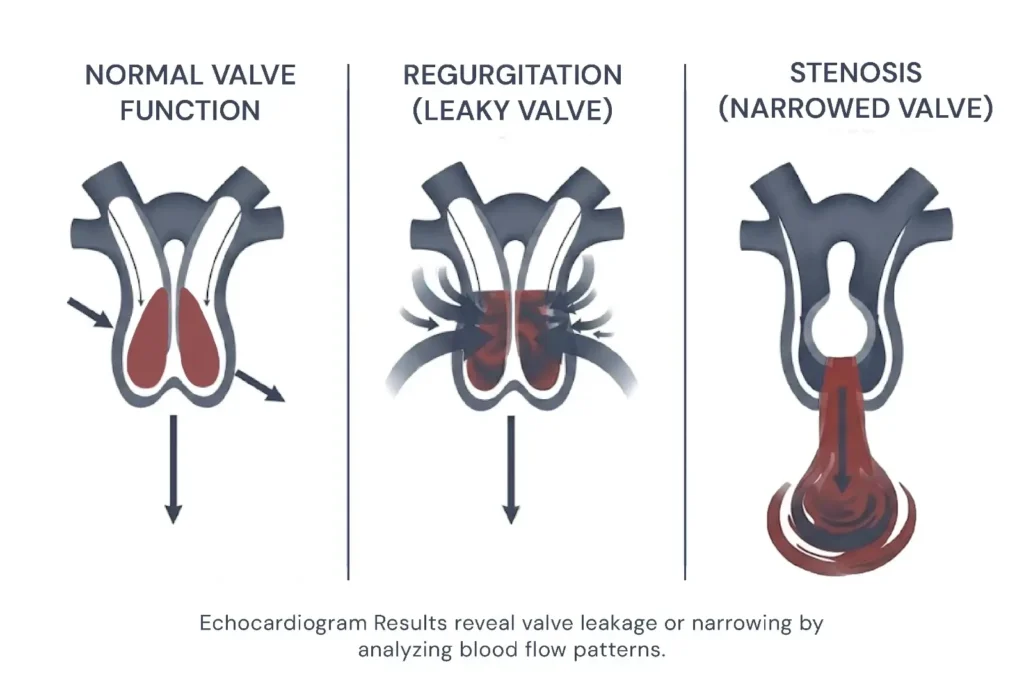
- Valvular Function: Evaluates how well the heart valves are working, helping detect issues like stenosis (narrowed valves) or regurgitation (leaky valves).
Have questions about your echocardiogram results? Book a private consultation with Dr Francesco Lo Monaco, consultant cardiologist at The National Heart Clinic in London, for expert, personalised guidance on your heart health.
Common Findings in an Abnormal Echocardiogram Report
An abnormal echocardiogram can detect a range of heart issues. Some findings may be mild and not require immediate attention, while others might need further testing or urgent treatment. A heart ultrasound is typically used to identify the following cardiac issues:
- Enlarged Heart (Cardiomegaly): It can be an indication of heart failure or other cardiac conditions.
- Fluid Around the Heart: Can be caused by an infection or inflammation.
- Low Ejection Fraction: A low EF (<50%) or low heart pumping can indicate heart failure or cardiomyopathy.
- Heart Valve Abnormalities: Narrowed (stenosis) or leaky (regurgitation) valves affecting the blood flow.
- Blood Clots or Tumours: Require urgent attention.
Also Read: Normal Vs Abnormal ECG
Normal Vs Abnormal Echocardiogram Results: A Quick Comparison Chart
| Measurements | Normal Echocardiogram | Abnormal Echocardiogram |
| Heart Wall Thickness | Walls are consistent and normal in thickness | Walls are too thick or too thin |
| LVESD (Left Ventricular End-Systolic Dimension) | Ventricle size after contraction falls within the expected range | An enlarged size may suggest the heart isn’t pumping efficiently |
| LVEDD (Left Ventricular End-Diastolic Dimension) | Ventricle size when relaxed and filled with blood is within the expected range | An enlarged size may indicate the heart is under strain or not functioning properly |
| Ejection Fraction (EF) | 55-70% | Below 55% may suggest heart failure |
| Stroke Volume (SV) | Blood ejected per heartbeat is within the healthy range | Reduced volume may suggest weakened heart function |
| Cardiac Output (CO) | Falls within the expected range for a resting adult | Too low may mean the heart isn’t meeting the body’s demands, too high may point to another underlying condition |
| Doppler Flow Velocities | Blood flows smoothly and at a normal speed through the heart | Irregular speed or direction may indicate a blockage or flow abnormality |
Understand the Difference Between ECG and Echocardiogram
How Long Does It Take to Get the Results of an Echo Scan?
Choosing echocardiography through the NHS may mean waiting weeks or even months for both your appointment and your results. If you need an urgent report from expert cardiologists, a private echocardiogram could be a better option. If you’re in London or the surrounding areas, you can book your echo scan with Dr Francesco Lo Monaco, a consultant cardiologist specialising in cardiac imaging. Same-day or next-day appointments are available, along with top-notch clinical facilities and fast turnaround on reports.
Abnormal Echocardiogram? What are the Next Steps?
If your echocardiogram report shows abnormalities, it’s important to consult a cardiologist at the earliest. Depending on the findings, you may be advised to undergo further heart tests for a comprehensive assessment. These tests may include cardiac CT or MRI, Stress Testing, and some blood tests.
Conclusion
Understanding your echocardiogram results is important to understanding your heart health better and taking a proactive approach to managing even minor issues earlier. However, you must not rely fully on self-assessment; instead, always consult a cardiologist for an accurate, detailed interpretation of your report.
If you’ve spotted an abnormal term in your results, don’t panic. Book your appointment with Dr Lo Monaco at The National Heart Clinic, London – a state-of-the-art clinical setup offering expert care and fast, reliable reporting.
Disclaimer
The information provided in this blog is for general information and educational purposes only. The content is not intended to be a substitute for professional medical advice, diagnosis, or treatment. Always seek the advice of your GP or a qualified medical professional regarding any medical condition. If you are experiencing a medical emergency, please contact emergency services immediately.