
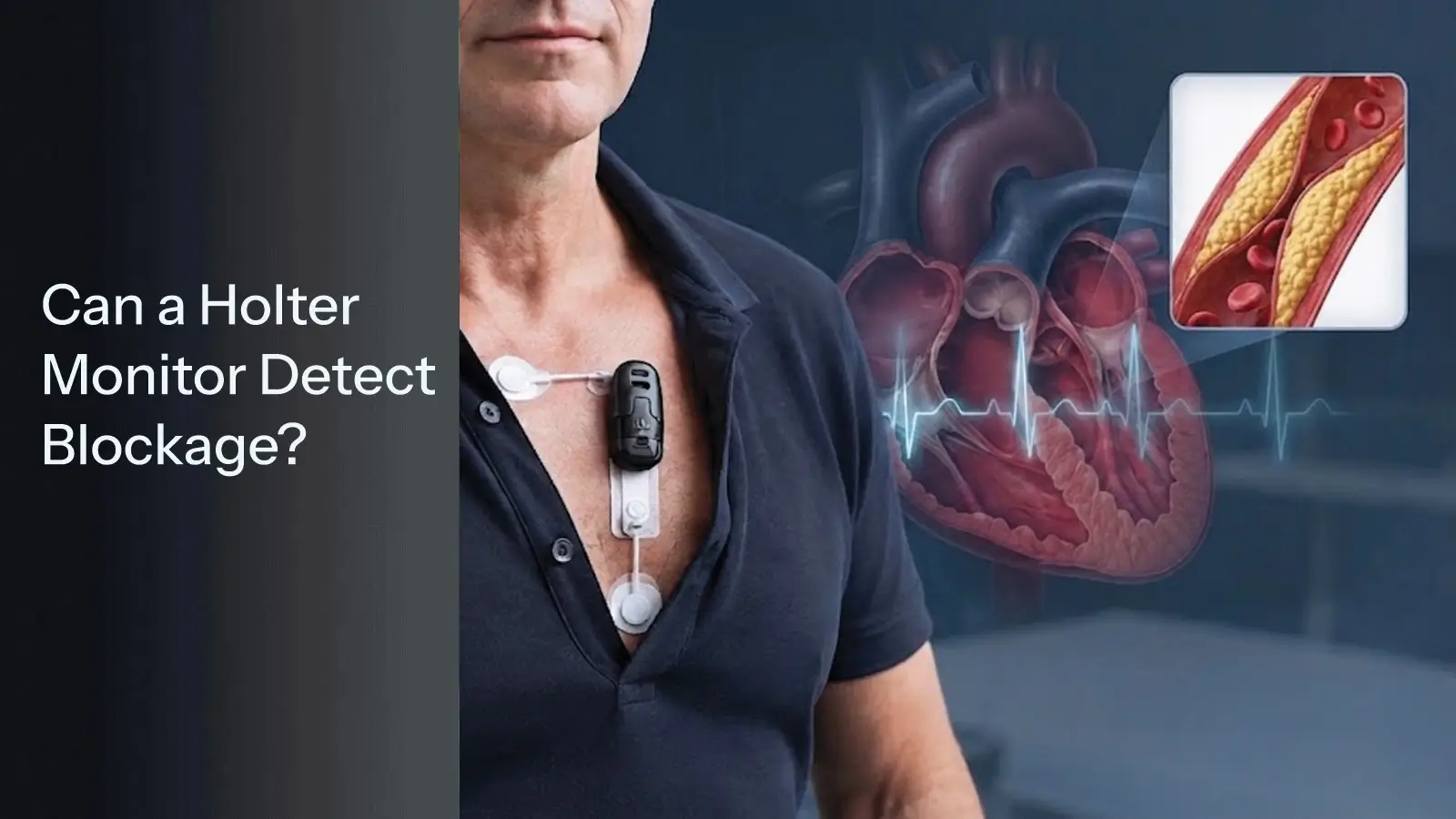
Can a Holter Monitor Detect Blockage? Explained
A Holter monitor, also known as an ambulatory ECG monitor, continuously records your heart’s electrical activity, usually for 24 hours to several days, depending on your symptoms and your cardiologist’s assessment. It is commonly used to investigate palpitations, arrhythmias and changes in heart rate.
A question we hear often is ‘Can a Holter monitor detect blockage?’ The simple answer is no; it cannot directly show blocked or narrowed coronary arteries. However, what it records can point your cardiologist toward further tests if something looks abnormal. In this guide, we explain exactly what a Holter monitor can detect, and which tests are actually used to check for coronary artery blockage.
Ambulatory ECG Monitoring
Monitor your heart rhythm over 24 hours to 14 days with specialist-led ambulatory ECG monitoring. Home monitoring options are also available where clinically appropriate.
What is a Holter Monitor?
A Holter monitor is a small, portable device that continuously records and monitors your heart’s electrical activity throughout the day. Unlike a standard ECG, which provides a snapshot of your heart rhythm, a Holter monitor records your heart activity for 24 hours or longer, sometimes up to 14 days, depending on your symptoms and your cardiologist’s assessment. You can go about your usual routine while wearing it, including sleeping, working, and light exercise.
What Does a Holter Monitor Actually Detect?
A Holter monitor can help your cardiologist catch episodic or hidden heart rhythm problems that could be missed during a simple ECG test. It can detect or record:

- Irregular heart rhythms, such as atrial fibrillation
- Ectopic beats (extra or skipped heartbeats)
- Palpitations (a racing, pounding, fluttering heartbeat)
- Dizziness or blackouts linked to an abnormal heart rhythm
Book Your Ambulatory ECG Monitor Now
Can a Holter Monitor Detect Blockage?
No, a Holter monitor does not directly detect or diagnose a blockage in the coronary arteries. It records your heart’s electrical activity and can flag abnormal rhythms or changes that may prompt your cardiologist to investigate further. But on its own, it cannot confirm whether your coronary arteries are narrowed or blocked.
If blockage is suspected, your cardiologist will usually recommend a different, more targeted test.
Can a Normal Holter Monitor Result Rule Out Heart Disease?
A normal ambulatory ECG monitoring result means no significant heart rhythm abnormality is detected during the monitoring period. However, it doesn’t rule out coronary artery blockage or other heart diseases.
What Heart Tests Can Identify a Blocked Heart Artery?
A coronary artery blockage involves narrowing or obstruction of the arteries that supply blood to the heart. Different tests can evaluate the heart’s blood supply or provide detailed insights about your coronary arteries, including:
- Exercise Stress Test: Helps analyse how your heart responds to physical exertion and may identify signs of reduced blood flow.
- Stress Echocardiogram: Uses ultrasound to evaluate how the heart muscle functions when it is under stress.
- CT Coronary Angiogram (CTCA): Produces detailed images of the coronary arteries and can identify any narrowing of arteries or plaque buildup.
- Coronary Angiography: An invasive test that provides detailed images of the coronary arteries and can help identify significant blockages.
Can a Holter Monitor Show a Heart Attack Risk?
A Holter monitor result can help your cardiologist to pick up rhythm changes that sometimes accompany reduced blood flow, but it is not specifically used to assess the risk of a heart attack. For detailed investigation, your cardiologist may combine it with other tests.
Conclusion
While a Holter monitor cannot detect a coronary blockage, it can provide valuable information about your heart rhythm and help identify abnormalities that may require further investigation. If you are experiencing palpitations, dizziness, chest pain or an irregular heartbeat, a cardiac assessment can help determine which tests are appropriate for you.
You can book a consultation with Dr Francesco Lo Monaco in London or choose an online cardiology consultation for greater convenience. Where clinically appropriate, home diagnostic services may also be arranged.
Disclaimer
The information provided in this blog is for general information and educational purposes only. The content is not intended to be a substitute for professional medical advice, diagnosis, or treatment. Always seek the advice of your GP or a qualified medical professional regarding any medical condition. If you are experiencing a medical emergency, please contact emergency services immediately.