
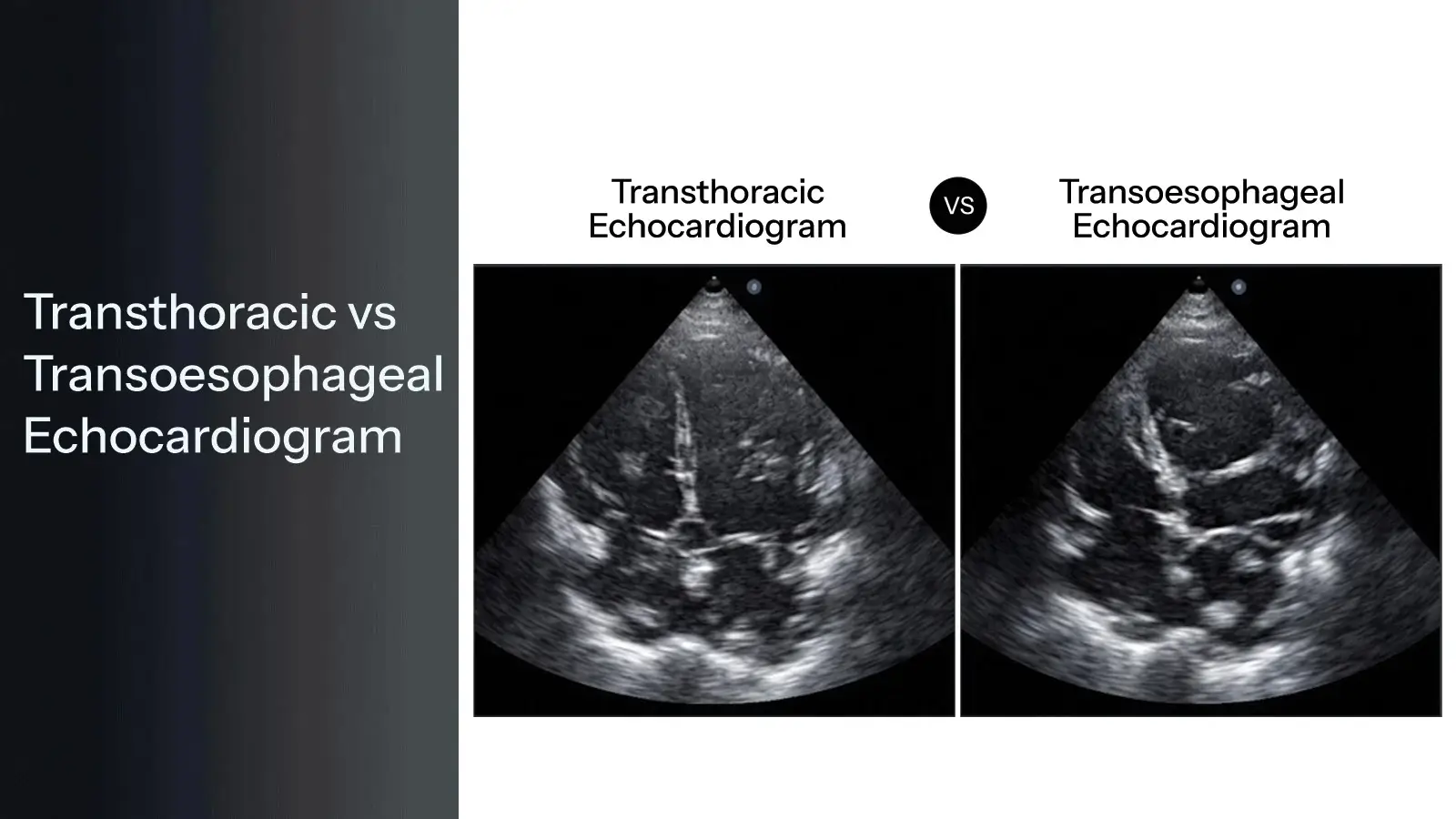
Transthoracic Vs Transoesophageal Echocardiogram: TTE Vs TOE
An echocardiogram is a diagnostic test to evaluate the heart’s structure and function and investigate a range of cardiovascular conditions. Your doctor recommends the most appropriate type of echocardiogram based on your symptoms, medical history, and the details required.
Transthoracic and transoesophageal echocardiograms are the two commonly used types of heart ultrasound. While both provide detailed images of the heart, they are performed differently and can provide different levels of detail.
Understanding the difference between TTE and TOE can help you know what to expect and why your cardiologist may recommend one test over the other. In this guide, we explain transthoracic vs transoesophageal echocardiograms, when they are recommended, how to prepare, and what each test shows about your heart health.
What is a Transthoracic Echocardiogram?
The transthoracic echocardiogram is a non-invasive cardiac scan that takes only 20-30 minutes. The procedure is simple – a sonographer applies gel to your chest and moves a handheld transducer across the chest to scan your heart. The TTE ultrasound takes place outside your body.
Preparing for Transthoracic Echocardiography
A TTE usually requires little or no preparation. You can eat, drink, and take your usual medications unless your doctor advises otherwise. Wear comfortable clothing that allows easy access to your chest for the scan.
Why You Might Need TTE
A transthoracic echo is a first-line cardiac test that is used for routine examination. It may be recommended to:
- Evaluate the heart’s structure and function.
- Investigate symptoms such as breathlessness, chest pain, or persistent fatigue.
- Check the heart’s pumping efficiency.
- Detect fluid around the heart
- Monitor a known heart condition or its treatment
What is a Transoesophageal Echocardiogram
A transoesophageal echocardiogram (TOE) is an advanced heart ultrasound used when more detailed images of the heart are needed. During the test, a small ultrasound probe is passed through the mouth and gently down the oesophagus, which lies directly behind the heart.
The probe captures detailed, real-time images of the heart without the ultrasound waves having to pass through the chest wall. As a result, TOE can provide a clearer view of certain heart structures and help your cardiologist assess the heart’s structure and function in greater detail.
Preparing for Transoesophageal Echocardiography
You usually need to fast for several hours before a TOE. Your cardiologist will provide specific instructions about fasting and any medications you take. As sedation is commonly used, you may need someone to accompany you home after the test.
Why You Might Need TOE
A transoesophageal echocardiography is an advanced form of heart ultrasound. It may be recommended to:
- Provide detailed imaging when a TTE doesn’t provide sufficient information.
- Evaluate the heart valves
- Investigate a stroke or TIA without obvious cause
- Detect blood clots, especially near the left atrial appendage
- Check the heart before or during procedures such as ASD closure, left atrial appendage (LAA) occlusion, mitral valve repair, or transcatheter aortic valve implantation (TAVI).
Also Read: Normal Vs Abnormal Echocardiogram Results
Transthoracic Vs Transoesophageal Echocardiogram: Key Differences Explained
| Feature | Transthoracic Echo (TTE) | Transoesophageal Echo (TOE) |
| How It Works | A doctor moves an ultrasound probe over the chest to capture images of the heart. | A small ultrasound probe is passed through the mouth into the oesophagus to obtain detailed images of the heart. |
| Invasive? | No | Yes, minimally invasive |
| Sedation Needed? | No | Usually Yes |
| Recovery Time | No recovery time needed | Usually requires a short recovery period after sedation. |
| Used for | Assessing heart structure, function, chambers, and valves. | Detailed evaluation of heart valves, blood clots, and other structures that are better visualised from the oesophagus. |
Deciding the Right Heart Test
You do not need to decide which type of echocardiogram you need. Your cardiologist will recommend the most appropriate test based on your symptoms, medical history and the information needed from the assessment.
A transthoracic echocardiogram (TTE) is usually the first-line test because it can provide detailed images of the heart without sedation or an invasive procedure. If a TTE does not provide enough information, or if more detailed imaging is needed, your cardiologist may recommend a transoesophageal echocardiogram (TOE).
In some cases, your cardiologist may recommend TOE from the outset when a detailed assessment of specific heart structures is needed.
Also Read: ECG Vs Echocardiogram
Conclusion
Transthoracic and transoesophageal echocardiograms provide different views of the heart and are used for different clinical needs. TTE is the standard, non-invasive option, while TOE provides more detailed views of certain heart structures. If you have cardiac symptoms or have been advised to have an echocardiogram as part of a heart health assessment, you can book your echocardiogram with Dr Francesco Lo Monaco at his clinics in London and Richmond. Benefit from the convenience of a same-day echocardiogram, with results reviewed by Dr Lo Monaco on the same day as your appointment. Online consultations are also available.
Disclaimer
The information provided in this blog is for general information and educational purposes only. The content is not intended to be a substitute for professional medical advice, diagnosis, or treatment. Always seek the advice of your GP or a qualified medical professional regarding any medical condition. If you are experiencing a medical emergency, please contact emergency services immediately.